
Master Every iBET Poker Game: Types, Rules, and How to Win
Different Types of Online Poker

Online poker comes in many forms, each with its own set of rules, strategies, and player dynamics. Whether you’re a beginner testing the waters or an experienced player looking to expand your game, mastering the key variations of online poker is essential for long-term success. In this guide, we explore three of the most common types of online poker—Texas Hold’em, Omaha, and Seven-card Stud—and offer actionable strategies to help you win.

Poker games have been a gambling sport longer for than anyone can tell, let’s also take a look at the history some famous poker players have created that we could keep in mind!
>> Lessons From the Best Poker Players Around the World
Introduction to Poker Variants and Game Mechanics
Poker has been a cornerstone of gambling culture for decades. While luck plays a part, understanding each poker variant’s structure and mechanics is key to building a consistent strategy. This article highlights the rules, pros and cons, and winning methods for three major types of online poker:
-
Texas Hold’em
-
Omaha Poker
-
Seven-card Stud
Each format offers a unique gameplay style and level of complexity. Beyond this, we’ll also take a look at general poker formats like cash games and tournaments, which impact how each variant is played online.
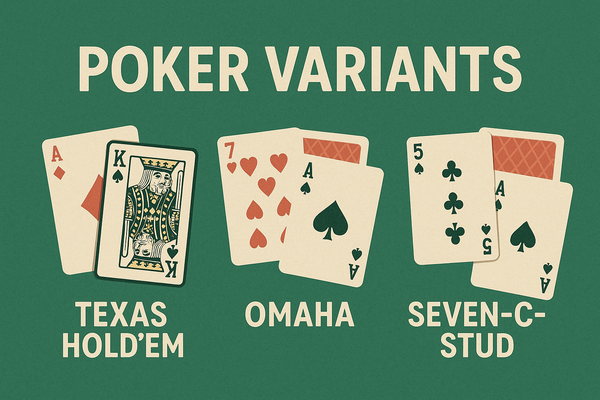
Texas Hold’em Poker: Simplicity Meets Skill
Texas Hold’em is the most popular online poker game globally. Its blend of straightforward mechanics and deep strategy makes it ideal for both beginners and seasoned pros.

How it works
-
Each player is dealt two hole cards.
-
Five community cards are placed face-up in stages: the Flop (3 cards), Turn (1 card), and River (1 card).
-
The objective is to make the best five-card hand using a combination of hole and community cards.
A round of betting follows each card reveal. Players can check, bet, raise, or fold, with the game ending either by a showdown or if all opponents fold.
Pros
-
Easy to learn and widely available across online casino platforms.
-
Suitable for both cash games and tournaments.
Cons
-
The action can be volatile, and less experienced players may be overwhelmed.
How to Win at Texas Hold’em
-
Position is power: The “Button” is the most advantageous seat. Being last to act lets you assess opponents’ moves before deciding.
-
Smart betting on Turn and River: Avoid chasing low-value draws. If you suspect you have the best hand after the Turn, increase the pressure. Be cautious when the board pairs or shows a flush possibility.
-
Know your opponents: Track betting behavior, bluff frequency, and common hand ranges by position. Use this to inform your own actions.
Omaha Poker: High Action, High Complexity
Omaha, particularly Pot Limit Omaha (PLO), is the second most played online poker variant. It features bigger pots and more dynamic hands than Texas Hold’em.

How it works
-
Each player gets four hole cards.
-
Five community cards are revealed in stages, like in Hold’em.
-
Players must use exactly two hole cards and three community cards to make their best hand.
The game proceeds with four betting rounds: Pre-Flop, Flop, Turn, and River.
Pros
-
High potential for large pots.
-
Bluffing is more common and impactful.
Cons
-
Not beginner-friendly.
-
More difficult to calculate outs and bet sizing.
How to Win at Omaha
-
Avoid small pocket pairs: They often lose value quickly post-flop.
-
Use bluffing sparingly: Unlike in Hold’em, most players in Omaha chase draws aggressively.
-
Be aggressive or fold: Avoid passive calling unless pot odds or trap plays are clearly in your favor.
Seven-card Stud: A Game of Patience and Observation
Seven-card Stud is a more traditional poker variant that rewards memory, focus, and discipline. Unlike Hold’em or Omaha, there are no community cards.

How it works
-
Each player posts an ante.
-
Players are dealt two hole cards face down and one face up (door card).
-
Betting rounds follow each new card dealt, with a total of seven cards distributed per player (three face down, four face up).
-
The best five-card hand wins in a showdown.
Pros
-
Strong emphasis on tracking visible cards and folded hands.
-
Less variance compared to Hold’em and Omaha.
Cons
-
Slower pace.
-
Less action makes it less popular on some online poker platforms.
How to Win at Seven-card Stud
-
Play high-ranking starting hands: Prefer high pairs or suited connectors.
-
Track folded cards: This helps in calculating odds and identifying dead outs.
-
Fold early when weak: Don’t chase against strong upcards unless you have equity.
nderstanding Poker Formats: Cash Games vs. Tournaments
Beyond game types, poker formats play a big role in strategy and risk management.

Cash Games
-
Players buy chips with real money.
-
Can join or leave anytime.
-
Win/loss is tied directly to chip value.
Tournaments
-
Fixed buy-in; everyone starts with equal chips.
-
Play continues until one winner remains or prize pools are distributed by ranking.
-
Tournaments require endurance, while cash games focus on edge and efficiency.
Choose based on your style: If you prefer consistency and flexibility, go for cash games. If you thrive in long-form competitive formats, tournaments are for you.
Final Thoughts: Mastering Your Poker Journey
Whether you’re just starting out or advancing into new poker variants, the key is practice and strategic growth. Many online poker free games, allowing you to explore different variants risk-free.
To recap:
-
Start with Texas Hold’em to learn fundamentals.
-
Move into Omaha once you’re confident and ready for high-stakes strategy.
-
Explore Seven-card Stud for a slower, more thoughtful pace.
-
Experiment with both cash games and tournaments to discover what suits your style.
With a strong understanding of rules, player tendencies, and betting patterns, you’ll be equipped to win more consistently—regardless of the variant.